First day back after half term: a 60-second routine and 12 starter questions
To get pupils focused on the first day back after half term, give them 60 seconds to write about the break, then pens down. Lower your voice for the next instruction, then start with a quick win: one question from before half term that every pupil explains in their own words. The room settles, and you find out what stuck before you teach anything new.
Two A4 pages. No sign-up to download. Free to copy, print and share with your department.
How do you settle a class after half term?
Use the same three steps every time. It takes about a minute before your first task.
- 60 seconds on the break. Then pens down.As they sit down: “You’ve got 60 seconds to write about your half term. Anything you like.” When the time’s up, pens down and eyes front. The holiday chat goes on paper, not across the room.
- Lower your voice.Give the next instruction a little quieter than usual. A calm, low voice sets the tone for the term far better than a loud one.
- Start with a quick win.Pick one question from this pack that everyone can have a go at and run it as a Get It? check. Every pupil explains it in their own words, and you see who kept it from before the break, by name.
What should the first lesson back after half term be?
Calm, familiar and low stakes. Pupils have had a week off, so start by finding out what they still know rather than piling on new content.
- Routines first. Same entry, same seating, same expectations as before the break.
- Retrieval before new teaching. Ask pupils to explain an idea from before half term, in their own words. More ideas in our guide to retrieval practice starters.
- Look for misconceptions. Each question below has a “Watch for” line. Here is how to spot misconceptions in a lesson.
- Decide: recap or move on. If most of the class explains it well, carry on. If not, you know what to reteach before it matters.
First day back starter questions for KS3 Maths
Three Year 7 and 8 recap questions on place value, negative numbers and fractions. Each one comes with a common misconception to watch for.
place value, negative numbers and adding fractions-
Year 7
Explain why 0.7 is bigger than 0.65, even though 65 is bigger than 7.
A good answer: Compares the tenths first: 7 tenths beats 6 tenths. Might write 0.7 as 0.70, so 70 hundredths against 65 hundredths.
Watch for: “More digits means bigger.”
-
Year 7
Explain why −8 is smaller than −3. Use a number line or a real-life example.
A good answer: −8 is further below zero, so it sits further left on a number line. A temperature of −8°C is colder than −3°C.
Watch for: “8 is bigger than 3, so −8 is bigger.”
-
Years 7-8
Explain why 1/2 + 1/3 is not 2/5.
A good answer: Halves and thirds are different sized pieces, so you can’t just add the tops and the bottoms. Make them sixths: 3/6 + 2/6 = 5/6. Bonus: 2/5 is less than 1/2, so it can’t be right.
Watch for: Adding the tops and adding the bottoms.
First day back starter questions for KS3 English
Three questions on language techniques, inference and word choice, from Year 7 up to Year 9.
similes, metaphors, inference and word choice-
Year 7
Explain the difference between a simile and a metaphor. Give your own example of each.
A good answer: A simile compares using “like” or “as” (the snow was like a blanket). A metaphor says one thing is another (the snow was a blanket). Stronger answers say what the comparison makes the reader picture or feel.
Watch for: Any comparison counts as a simile.
-
Years 7-8
A character slams the door and says nothing at dinner. What can you infer about how they feel? Explain which clues tell you.
A good answer: Infers a feeling that is never stated, such as angry, upset or hurt, and links it to the clues: “slams” suggests force or anger, the silence suggests they are withdrawn or holding something back.
Watch for: Retelling what happens instead of inferring.
-
Years 8-9
A writer describes a house as “crouching at the end of the lane”. What does “crouching” suggest, and why might the writer have chosen it?
A good answer: Spots the personification: the house seems alive. “Crouching” suggests hiding, waiting or about to pounce, so it feels threatening. Links the word to the mood the writer wants.
Watch for: Naming the technique with no comment on its effect.
First day back starter questions for KS3 Science
Three Year 7 and 8 questions on cells, particles and balanced forces, the big ideas most KS3 courses start with.
cells, particles and balanced forces-
Year 7
Explain two differences between a plant cell and an animal cell, and why a plant cell needs them.
A good answer: Any two: a cell wall (strengthens and supports the cell), chloroplasts (where photosynthesis happens), a permanent vacuole (filled with cell sap, keeps the cell firm). Animal cells have none of these.
Watch for: “Plant cells have a cell wall instead of a membrane.” They have both.
-
Year 7
Using particles, explain why you can squash a gas but you can’t squash a solid.
A good answer: Gas particles are far apart with lots of space between them, so they can be pushed closer together. Solid particles are tightly packed in a fixed pattern and only vibrate, so there is no space to close.
Watch for: “The particles themselves get smaller.”
-
Years 7-8
A book is resting on a table and not moving. Explain what forces act on it and why it stays still.
A good answer: Its weight (gravity) pulls it down and the table pushes up with a support force (normal contact force). They are equal in size and opposite in direction, so the forces are balanced and its motion doesn’t change.
Watch for: “No forces act on it because it isn’t moving.”
Retrieval questions for any subject
Three question frames for any subject and any year. Swap the bracket for your own key word or topic from before half term.
your real topic from before half term, e.g. “the causes of World War One”-
Any year
In your own words, what does [key word] mean? Give an example of it.
A good answer: An accurate meaning in their own words, not a copied definition, plus an example that genuinely fits.
Watch for: A word-perfect definition with a wrong example. It was memorised, not understood.
-
Any year
What’s the most common mistake people make with [topic], and how do you avoid it?
A good answer: Names a real, specific mistake and explains the right way and why. Spotting the trap shows they understand the idea, not just the steps.
Watch for: “Not checking your work.” Too vague to tell you anything.
-
Any year
Explain [topic] to someone who missed every lesson on it. Start with the most important idea.
A good answer: Leads with the central idea, gets it right, puts the steps in a sensible order and uses an example. What they leave out tells you what didn’t stick.
Watch for: A list of facts with no link between them.
How to run a first day back check in Get It?
- Pick your classSign in at app.dotheygetit.app and choose your class. First time? Add a class and paste your class list in once, one name per line.
- Type the topicUnder New check, type the topic in “What did you teach?” (we give you the words below) and press 1. Generate questions.
- Swap in our questionsClick into a question, select it all and paste ours over it. Remove spares with ✕ or use + Add question. Then press 2. Create check.
- Code on the boardShow the class code or the QR code. Pupils pick their name and explain each answer in their own words. You see Get it, Shaky or Struggling for each pupil, by name.
No devices in your room? Every question works just as well on mini whiteboards or paper. Not sure which suits your room? Read mini whiteboards vs digital checks.
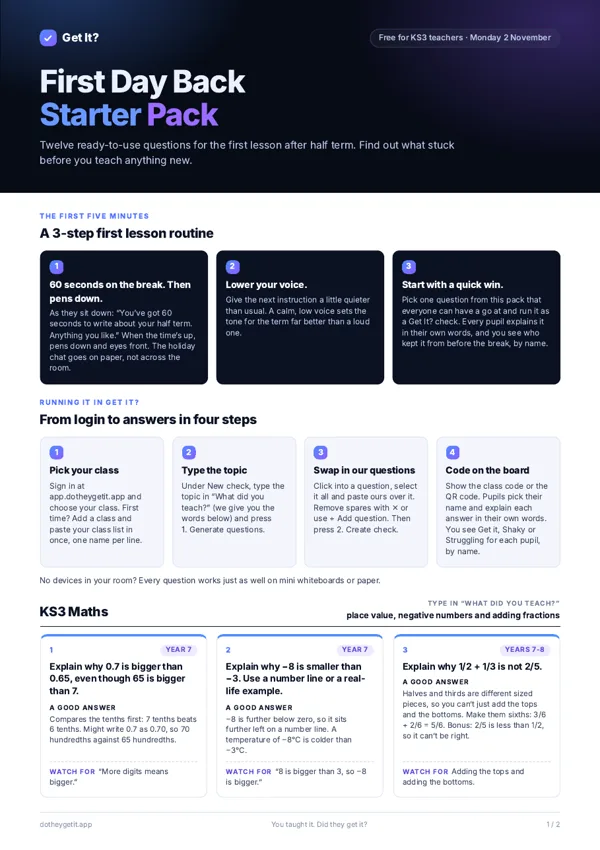
Download the First Day Back Starter Pack
All 12 questions, what a good answer includes, the misconception to watch for, and the 60-second routine. Two A4 pages, printer friendly.
Download the free PDFFirst day back after half term: common questions
How do you settle a class after half term?
Give pupils 60 seconds to write about their half term, then pens down, so the holiday chat goes on paper instead of across the room. Give your next instruction in a lower, calmer voice. Then start a short task everyone can have a go at, such as one retrieval question from before the break.
What should the first lesson back after half term be?
Keep it calm and low stakes. Re-establish your routines, then spend the first few minutes on retrieval: ask pupils to explain something they learned before the break. What they remember tells you whether to recap or move on, before you start new content.
Why ask pupils to explain in their own words instead of a quick quiz?
A multiple-choice quiz can be answered by recognising or guessing. Asking pupils to explain an idea makes them recall it and put it together themselves, so gaps and misconceptions show up in what they write or say.
Can I use these questions without Get It?
Yes. Every question works on mini whiteboards, in exercise books or on paper. Get It? lets every pupil answer at once on a device and shows you who got it, by name, without marking.
Which year groups are the questions for?
The Maths, English and Science questions are KS3 and each is tagged with a year group, from Year 7 to Year 9. The any-subject questions work with any class: you fill in the key word or topic.
Is Get It? free?
Get It? is free while in beta, and pupils need no account. It is made for UK KS3, KS4 and GCSE teachers.
See who got it, by name, before new teaching
Type the topic you taught. Every pupil explains it in their own words, and you see Get it, Shaky or Struggling for each one. No marking.
Free while in beta · pupils need no account